
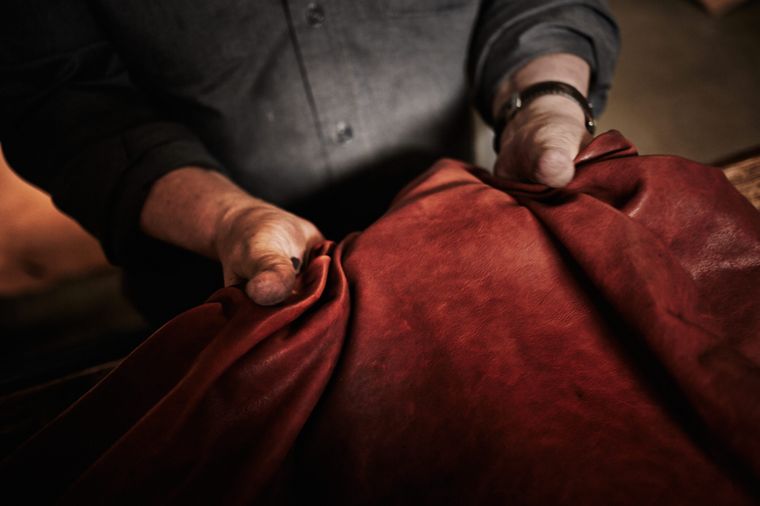
Leather is among the earliest materials ever used by man, its earliest use traces to the Stone Age, where hunter-gatherers used the skins of their kills for primitive shelter, clothing and toolmaking. It is hypothesised that leather tanning was discovered when skins were discarded into pools of water and fallen leaves on the forest floor. Left long enough, the tea of composting leaves and water transformed the texture, colour and odour of the skins, making them more durable and useful than untreated hide. Through trial and error, vegetable tanning was discovered, delivering a material still widely used today.
Natural tanning has a rich history. The oldest leather tools, stones sharpened to scrape hides, have been dated to about 82,000 years ago and were discovered in NTE's home country of South Africa. The oldest leather footwear item, the Areni-1 shoe, is over 5,500 years old and remains in outstanding condition.
Early processes used salt, clay, urine, lime, brains, vinegar and tree bark. The word tannin is derived from the Latin tannum, meaning oak bark. Extracts from trees like cedar, hemlock, oak and chestnut proved highly effective because of their above-average tannin levels.
Tanning leather the natural way
Today there is increasing consumer demand for naturally tanned leather, but many natural alternatives pose their own environmental issues. Quebracho and chestnut, both good sources of tannin, are slow-growing trees not sourced from reforested plantations. While chestnut trees are not always felled for their tannins, quebracho trees are, with significant impact on forests in Argentina and Paraguay where the trees typically take a century to reach maturity. This has been a valid criticism of vegetable tanning.
The black wattle, Acacia mearnsii, is different. A legume with exceptionally high levels of natural catechol tannins in its bark, it was introduced to South Africa from Australia in the 19th century and thrives in the mist belt across the KwaZulu-Natal Midlands, northern KwaZulu-Natal, Mpumalanga and Eswatini, where it is grown commercially, mostly by small-scale farming operations.
Black wattle is hardy and rapid-growing, surviving even extreme drought. Reaching maturity in around 8 years, it is a nitrogen-fixer that enriches the soil it grows in, and its natural pest resistance reduces the need for pesticides. The short growing cycle, soil-restorative qualities and excellent return on land that would otherwise not be commercially viable make it an ideal crop for small-scale and environmentally conscious growers.
From plantation to factory
NTE Mimosa's wattle plantations have always been maintained with careful land and resource management, and NTE's extract carries PEFC chain-of-custody certification. Forests are not converted from indigenous areas of any conservation value, and environmental impact assessments ensure both local communities and ecology are protected.
NTE is wholly owned by the wattle growers, with over 700 shareholders ranging from large-scale operations to small community grower operations, today one of the world's largest growers of Acacia mearnsii, with over 68,000 hectares under management. The wattle bark is processed and the mimosa extracted at two world-class factories at Iswepe and Hermannsburg. At every step from seedling to delivery, NTE aims to minimise the environmental and carbon impacts of its operations, and the wood itself is a sought-after commodity, providing high-yield pulp and dense woodchips.
Supporting small-scale growers
NTE is committed to supporting and uplifting the businesses of its shareholders and growers. Through community-based enterprises such as Eyethu Farming, Ikhasi Agri Farming, Isigelane CPA and Ituba Agriculture, NTE offers financial, mentorship and forest-stewardship support, and provides a secure market for their bark.
Explore the Mimosa product range or read about our chain of custody.